


The Art of Building Sustainable Teams: Why Individual Brilliance Is the Wrong Foundation

Star individual performers often make terrible team leaders. The skills that make someone an exceptional individual contributor rarely translate to building high-performing teams — and the organisations that confuse the two pay for that confusion repeatedly, in turnover, fragility, and the quiet loss of potential that never got the conditions it needed to surface.

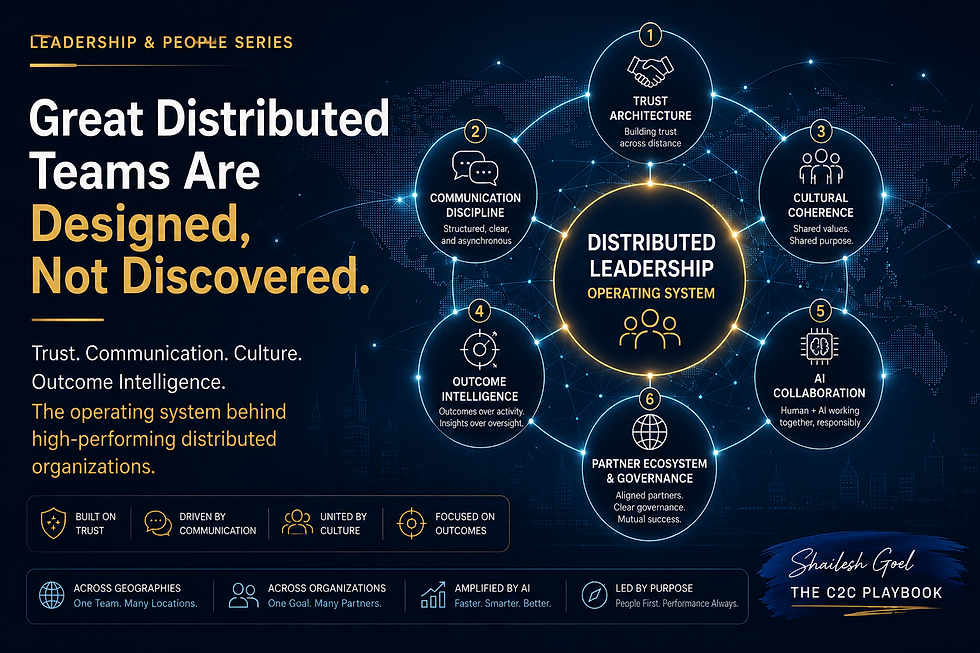
This is the third post in a series on leadership beyond formal authority. The first explored the philosophy and architecture of building influence across extended ecosystems. The second examined the execution disciplines that make distributed and partner teams perform at the level of the best co-located ones. This post goes to the foundation beneath both: what does it actually take to build a team that sustains high performance over time — not through the heroic effort of a few exceptional individuals, but through the collective capability of the whole?
The question matters more now than it ever has. Three forces are converging to make sustainable team building a strategic imperative rather than a management preference: the accelerating pace of AI-driven change that makes any team built around individual skill stacks increasingly fragile; the growing evidence that psychological safety — not talent density — is the primary predictor of team performance; and the compounding competitive advantage that comes from institutional knowledge embedded in team practices rather than in individual heads.
After three decades leading teams across manufacturing, automotive, and technology sectors — and as a certified Mental Health First Aider who has seen firsthand how the quality of the human environment shapes what teams can achieve — I want to offer a practical architecture for sustainable team performance. Not principles, but mechanics.
The Star Performer Trap — Why Individual Brilliance Damages Team Performance
The instinct to build teams around exceptional individuals is understandable. Star performers are visible, measurable, and reassuring. When a project is in trouble, the impulse is to find the best person available and put them on it. When a team is underperforming, the instinct is to replace weak links with stronger ones. The entire talent management infrastructure of most organisations — how people are identified, developed, rewarded, and promoted — is built around the individual unit of performance.
The problem is not that individual excellence does not matter. It clearly does. The problem is what optimising for individual brilliance does to the collective environment that makes sustained high performance possible.
Knowledge hoarding becomes rational behavior
In environments that reward individual performance, knowledge is power — and sharing it dilutes that power. Star performers in competitive environments learn, often unconsciously, to be the person who knows something others do not. This behaviour is entirely rational given the incentive structure, and entirely corrosive to the team's collective capability. The team becomes a collection of individual knowledge silos rather than an integrated intelligence, and its ability to solve problems that require synthesis across domains degrades steadily over time.
Single points of failure compound invisibly
Teams built around star performers develop structural fragilities that are invisible until they activate. When the key person leaves — and key people always eventually leave — the team does not just lose one contributor. It loses the informal knowledge, the relationship networks, the unwritten processes, and the judgment that were never transferred because the star performer model never created the conditions for transfer. The loss is discovered retrospectively, often months after the departure, when the team encounters a problem it would previously have solved quickly and finds it cannot.
The culture of comparison kills psychological safety
Perhaps the most damaging effect of star performer cultures is what they do to everyone who is not the star. Comparative performance environments — where individual contributions are visible and ranked, even informally — create the conditions in which the majority of team members are perpetually aware of where they rank relative to the highest performer. This awareness suppresses exactly the behaviours that make teams excellent: the willingness to raise uncertain ideas, admit mistakes early, ask questions that might seem naive, and take the kind of developmental risks that are essential to growth.
As a certified Mental Health First Aider, I have seen this dynamic play out with significant personal consequences for the individuals involved — not just performance consequences, but wellbeing consequences. The anxiety of operating in a comparative, high-visibility environment where weakness is punished is not a background condition. It is an active impediment to the cognitive flexibility and creative risk-taking that complex work requires.
The star performer trap is not about the star performers themselves. It is about what the system built around them does to everyone else — and therefore to the team's collective capacity to perform sustainably over time. |
Psychological Safety as Operational Discipline — Not Cultural Aspiration
Psychological safety has been one of the most widely cited concepts in team leadership for the better part of a decade, since Google's Project Aristotle identified it as the strongest predictor of team effectiveness. It has also become one of the most widely misunderstood — treated in many organisations as a cultural value to aspire to rather than an operational discipline to build and maintain through specific, deliberate leadership behaviours.
The distinction matters enormously. A cultural aspiration requires no particular action — you declare the value, include it in your leadership principles, and assume the environment will adjust. An operational discipline requires specific practices, regular measurement, and active course-correction when the conditions degrade. The former produces organisations that say they value psychological safety. The latter produces teams that actually have it.
What psychological safety looks like in practice
Psychological safety is not the absence of accountability or challenge. Teams with high psychological safety are often highly demanding — they hold each other to rigorous standards, engage in substantive disagreement, and push back on ideas that are not well-reasoned. What distinguishes psychologically safe environments is not the absence of difficulty but the nature of the response to mistakes, uncertainty, and dissent.
In a psychologically safe environment, raising a concern is welcomed rather than managed. Admitting uncertainty is seen as intellectual honesty rather than weakness. Making a mistake that is disclosed early and transparently is treated as valuable information rather than evidence of inadequacy. These responses are not automatic — they are learned through consistent leadership behaviour that either reinforces or undermines them over time.
The specific leadership behaviours that build psychological safety
• Modelling vulnerability explicitly — leaders who share their own uncertainties, mistakes, and developmental edges create permission for others to do the same. This is not performance; it requires genuine willingness to be seen as uncertain or wrong in front of the team. In my experience across multiple industries and cultures, this single leadership behaviour has more impact on team psychological safety than any structural or process intervention.
• Responding to bad news with curiosity rather than judgement — the moment a leader responds to a disclosed problem with blame, defensiveness, or the implicit message that the problem should have been prevented, they teach the team that bad news is dangerous to share. The pattern correction is specific: respond to every disclosed problem first with 'thank you for raising this early' before anything else. The team learns what early disclosure produces, and adjusts accordingly.
• Making disagreement explicit and structured — psychologically safe teams do not avoid conflict; they channel it productively. Leaders who name the disagreement in the room, invite all perspectives explicitly, and separate the evaluation of ideas from the status of the people proposing them create the conditions in which diverse thinking can surface and be heard.
• Following up on raised concerns consistently — one of the fastest ways to destroy psychological safety is to invite concerns and then fail to respond to them. Teams learn very quickly whether raising a concern produces a genuine response or a performance of listening followed by no change. Consistent follow-up — even when the answer is 'we considered this and decided not to act on it, here is why' — is what builds the trust that makes sustained disclosure possible.
From experience: When we improved deployment efficiency from 88% to 95%, the operational changes — the Planisware implementation, the structured resource planning processes — were necessary but not sufficient. What made the change sustainable was the team environment in which people felt safe to flag deployment mismatches early, raise concerns about capacity before they became delivery risks, and challenge allocation decisions that seemed suboptimal. The psychological safety was the infrastructure that made the operational improvements stick. |
Distributed Leadership in Practice — The Mechanics Most Writing Skips
The principle of distributed leadership — spreading leadership functions across team members based on their strengths rather than concentrating them in a single hierarchical position — is well established in organisational theory. The mechanics of how to actually implement it in a real delivery environment, without losing accountability or creating the diffuse responsibility that is the most common failure mode, are discussed far less often.
Distributed leadership does not mean everyone leads everything. It means that different leadership functions — technical direction, quality governance, stakeholder communication, team development, process improvement, risk identification — are held by the team members best positioned to exercise them, rather than defaulted to the person with the highest formal seniority.
Identifying who holds which function
The starting point is an honest, collective mapping of where leadership capability actually exists in the team — not where the org chart says it should exist. This requires a level of transparency about individual strengths and limitations that most team cultures have not developed, and a leadership environment secure enough to allow that transparency without it being weaponised in performance conversations.
In practice, the mapping happens through observation over time: who consistently surfaces the risks that others miss? Who has the relationships with external stakeholders that make difficult conversations productive? Who can see the process improvement opportunity that is invisible to everyone else because they are too close to the work? Naming these capabilities explicitly — and making the naming a positive act of recognition rather than a comparative ranking — is the first step toward distributed leadership becoming operational rather than aspirational.
Maintaining accountability without hierarchy
The most common failure mode of distributed leadership is the diffusion of accountability — situations where responsibility is notionally shared and therefore effectively owned by no one. Preventing this requires more explicit accountability structures than hierarchical leadership, not fewer.
The discipline that works is outcome-specific accountability mapping: for every significant outcome the team is responsible for, there is a named individual who is accountable for ensuring it happens — not for doing all the work themselves, but for ensuring the work gets done, the right people are engaged, and problems are surfaced and resolved before they become delivery failures. This accountability is visible to the whole team, and it is reviewed regularly in terms of whether the named individual needs more support, more authority, or more resources to fulfil it.
Distributed leadership across cultures and geographies
The previous posts in this series covered the cultural dimension of influence beyond authority and the specific challenges of managing distributed teams across geographies. Distributed leadership adds a further complexity: authority signals and leadership legitimacy are culturally constructed, and what reads as confident, appropriate leadership in one cultural context may read as presumptuous or overstepping in another.
The practice that navigates this most effectively is explicit mandate — making visible, in the whole team, what each person's leadership function is and what authority they hold to exercise it. When the team collectively understands and endorses that a specific person holds the quality governance function, for example, that person can exercise that function across cultural contexts without the authority being questioned, because it rests on collective mandate rather than individual assertion.
Distributed leadership is not the absence of accountability — it is accountability redesigned for the reality that in complex, fast-moving delivery environments, no single person has the judgment, relationships, and domain knowledge required to hold all leadership functions simultaneously. Making that distribution explicit is what prevents it from becoming diffuse. |
How AI Changes What Makes a Team Member Valuable
The arrival of AI as an active participant in knowledge work is changing the economics of individual capability in ways that have direct implications for how sustainable teams should be built and what they should optimise for.
For most of the history of professional work, individual value was primarily a function of knowledge and skill — what you knew and what you could do with it. AI is making significant categories of knowledge and skill abundant and cheap: drafting, synthesis, pattern recognition, code generation, research, translation, data analysis. The individual who was valuable primarily because they could produce these outputs quickly and reliably is in a fundamentally different competitive position than they were three years ago.
What AI cannot replicate — at least not yet, and not in the ways that matter most for complex delivery — falls into three categories: judgment in genuinely ambiguous situations where the right answer is not determinable from data alone; relationships built on trust, shared history, and the kind of mutual understanding that comes from sustained human engagement; and cross-domain synthesis that requires not just connecting information from different fields but understanding the context, constraints, and implications that give that connection meaning.
The team composition implication
For sustainable team building, this shift means that the characteristics that make a team member most valuable are changing. Deep, narrow technical expertise in domains where AI performs well is becoming less differentiating. The ability to exercise judgment, manage relationships, synthesise across domains, and work effectively with AI as a collaborator is becoming more so.
Teams built for the AI era are not teams with the deepest individual knowledge stacks. They are teams with the highest collective judgment quality — where diverse perspectives, strong relationships between members, and the psychological safety to challenge each other's thinking produce decisions and solutions that no individual or AI system could produce alone.
AI and the star performer dynamic
AI is also changing the star performer dynamic in an interesting and potentially constructive way. As AI tools handle more of the individual productivity work that previously defined star performance, the visible differentiators of individual contribution are shifting toward exactly the collective capabilities — collaboration, knowledge sharing, mentoring, cross-team coordination — that sustainable team building has always required but individual performance systems have undervalued.
Organisations that update their performance frameworks to reflect this shift — measuring contribution to collective capability alongside individual output — will find that the star performer trap becomes less sticky. When the behaviours that build sustainable teams are the same behaviours that are recognised and rewarded, the incentive to hoard knowledge, protect individual advantage, and avoid the vulnerability that psychological safety requires begins to dissolve.
The implication: Build teams for the capabilities AI cannot replicate. Hire and develop for judgment, relationship quality, learning agility, and the willingness to contribute to collective intelligence. These are the human capabilities that will compound in value as AI handles more of the knowledge work that individual expertise previously provided. |
The Compounding Return on Institutional Knowledge — Why Sustainable Teams Are Long-Term Assets
Of all the advantages that sustainable teams produce over star performer models, the one that is most undervalued in most organisations is the accumulation of institutional knowledge that is embedded in team practices rather than in individual heads.
In a star performer model, knowledge lives with people. When people leave — and in most industries and organisations, turnover is significant — the knowledge leaves with them. The organisation gets good at bringing new people up to speed, but it never gets ahead of the curve because the knowledge base keeps resetting with every departure.
In a sustainable team model, knowledge lives in the practices, relationships, and shared understanding of the team. When an individual leaves, the team loses a contributor but not the accumulated learning that shaped how it works. The knowledge base does not reset — it is maintained and built upon by the team that remains.
What institutional knowledge actually consists of
Institutional knowledge is often described as if it were primarily technical — the specific systems, processes, and domain expertise that a long-tenured person holds. This is part of it, but the more valuable and more durable component is relational and contextual: why certain decisions were made the way they were; what has been tried and failed, and why; which stakeholder relationships require particular care and how they have been developed; what the team's working norms are and where they came from.
This relational and contextual knowledge is almost never documented, because it lives in the interactions between people rather than in any individual's head. Sustainable teams — with their higher relationship quality, distributed leadership, and psychological safety — are far better at preserving this knowledge through transition than teams organised around individual star performers, because the knowledge is embedded in the team's collective practices rather than in any single person's expertise.
Building knowledge transfer into team practice
• Regular retrospectives that capture not just what happened but why decisions were made — creating a living record of the team's learning that survives individual departures.
• Structured pair work and rotation that ensures knowledge of critical processes and relationships is held by at least two team members at all times — not as a backup measure but as a development practice that builds collective capability.
• Explicit onboarding into team norms and history, not just technical processes — ensuring that new team members understand the context behind how the team works, not just the mechanics of what it does.
• Leadership transition practices that treat the handover of leadership functions as a deliberate, team-visible process rather than a private arrangement between individuals — so the team's collective understanding of who holds what accountability is maintained through change.
In the AI era, the value of this institutional knowledge compounds further. Teams that have developed strong shared practices for working with AI tools — understanding where AI output needs human review, how to structure prompts for their specific domain, what the failure modes of AI-assisted work look like in their context — develop a collective AI literacy that is far more valuable than any individual's AI skill, because it is embedded in the team's shared way of working and survives individual turnover.
The competitive advantage of sustainable teams is not visible in any single quarter. It accumulates over time in the form of institutional knowledge that does not leave when individuals do, relationships that make stakeholder management faster and more reliable, and collective judgment that improves with every problem the team solves together. |
Building the Conditions for Sustainable Performance — A Practical Framework
The five dimensions above point toward a set of concrete practices that organisations serious about sustainable team building need to invest in deliberately. These are not aspirational principles — they are operational commitments that require specific leadership behaviour, consistent application, and regular measurement.
Redesign your performance framework
The single most powerful structural intervention is changing what gets measured and rewarded. Individual output metrics are necessary but not sufficient. Add explicit measures of collective contribution: knowledge sharing, mentoring investment, cross-team collaboration, participation in team development activities, and the quality of handovers when transitioning work. Make these visible and valued in the same forums where individual performance is discussed.
Invest in psychological safety as an operational discipline
Conduct regular, structured psychological safety assessments — not annual surveys but quarterly team conversations that surface how safe people actually feel to raise concerns, admit mistakes, and challenge ideas. Train leaders in the specific behaviours that build and damage psychological safety. Make the assessment results visible to the whole team, not just to leadership.
Map and make visible your distributed leadership structure
Explicitly identify who holds which leadership function in your team, and make that mapping visible to everyone. Review it regularly — as team composition changes and as the work evolves, the distribution of leadership functions should evolve too. Treat leadership function transitions as team events, not private arrangements.
Build AI literacy collectively, not individually
Rather than allowing individual team members to develop their own AI practices independently, invest in building shared team practices for AI collaboration: where AI output gets used directly, where it requires human review, what the quality standards are, and how the team's AI-assisted workflows are designed and refined over time. Collective AI literacy is more resilient and more valuable than the sum of individual AI skills.
Create institutional knowledge practices that outlast individuals
Build retrospectives, pair work, structured rotation, and explicit knowledge transfer practices into your team's operating rhythm. Treat the preservation of institutional knowledge not as an HR function but as a team performance function — because in sustainable teams, it is.
The Foundation Beneath Everything Else
The posts in this series have moved from the philosophy of influence beyond authority, through the execution disciplines of distributed team management, to this: the conditions that make teams sustainable in the first place. Each layer depends on the one beneath it. You cannot build influence across extended ecosystems without trust. You cannot build trust in distributed teams without communication discipline and psychological safety. And you cannot build sustainable teams without the willingness to move beyond individual brilliance as the organising principle.
That last move is the hardest, because it requires organisations to change not just their practices but their instincts — the deep preference for visible, measurable individual excellence over the quieter, slower, more durable capability of collective intelligence. The organisations that make that move find that the returns compound in ways that no star performer strategy ever matches: teams that learn faster, adapt more readily, retain their capability through transition, and produce the kind of complex, integrated thinking that neither individual brilliance nor AI can substitute for.
In an environment where AI is rapidly commoditising individual skill, the sustainable team — with its psychological safety, distributed leadership, institutional knowledge, and collective judgment — is becoming not just a leadership preference but a competitive necessity. The organisations that understand this now will have a head start that compounds with every year they invest in it.
Sustainable team performance is not built on the brilliance of the individuals in the team. It is built on the conditions that allow collective intelligence to flourish — psychological safety, distributed accountability, knowledge that lives in practices rather than people, and the deliberate investment in the human infrastructure that AI cannot replicate. That infrastructure is the most durable competitive advantage available. |
This is the third post in a leadership series at shaileshgoel.in. Related reading: 'Leading Beyond Authority: How to Build Influence That Outlasts Any Org Chart' and 'Managing Remote and Partner Teams: What a Decade of Distributed Leadership Teaches'.

Comments