


Managing Remote and Partner Teams: What a Decade of Distributed Leadership Teaches You That 2020 Did Not

Everyone became a remote work expert in 2020. But the leaders who were managing distributed teams, global partner networks, and cross-continental delivery ecosystems long before the pandemic have a different set of lessons — and some of them cut directly against the conventional wisdom that emerged from the crisis.
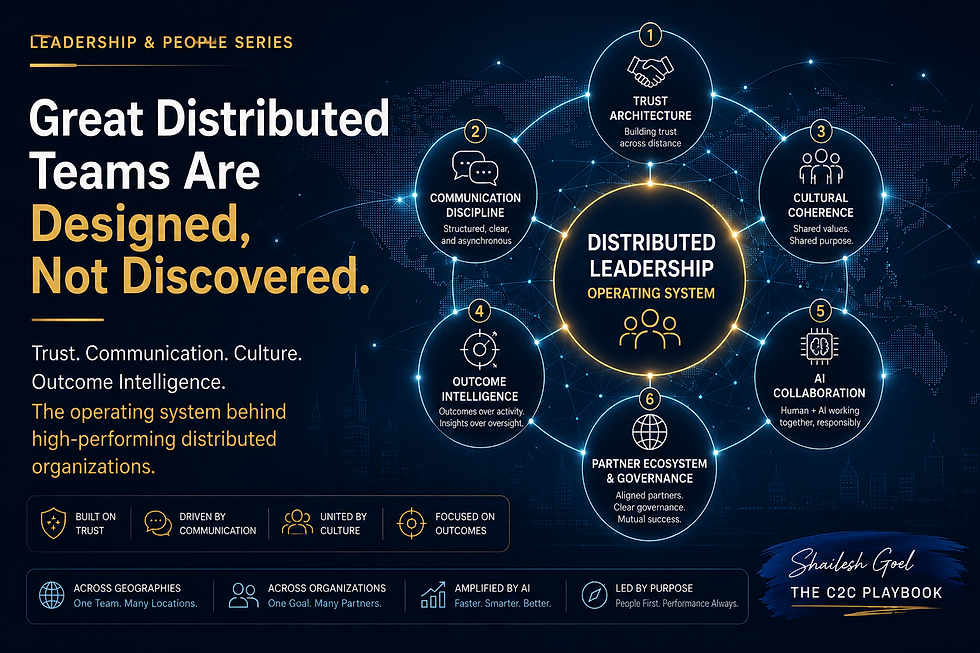
I began managing remote and partner teams seriously around 2010 — when working across time zones was an operational necessity, not a management philosophy, and when the tools available were a fraction of what teams now take for granted. There were no enterprise collaboration platforms, no sophisticated video conferencing, no AI-assisted communication tools. There was email, occasional phone calls, and the discipline of structured process.
What that environment taught — through a decade of building delivery ecosystems across India, Europe, the US, the Middle East, and APAC before the pandemic transformed remote work from exception to norm — is a set of lessons that are genuinely different from those that emerged from the 2020 experiment.
Not because the 2020 experience was wrong. But because leading remote teams under pressure, without preparation, and with the expectation that it would be temporary, teaches different things than building distributed delivery systems deliberately over years with the intention of making them permanently excellent.
This blog is an attempt to share those lessons — including what a decade of experience shows that the post-2020 generation of remote work adopters consistently underinvests in, and how the arrival of AI is now changing the distributed leadership challenge in ways that make some of these lessons more important, not less.
It is also the second in a series on leadership beyond formal authority. If the first post — on building influence across extended ecosystems — addressed the philosophy of leading where org charts end, this one addresses the execution: the specific practices, structures, and mindsets that make distributed teams perform at the level of the best co-located ones, and increasingly better.
What the 2020 Generation of Remote Work Adopters Still Gets Wrong
The 2020 transition to remote work produced an enormous volume of advice, frameworks, and best practices — most of it generated by people who had been doing it for months rather than years, and much of it shaped by the specific conditions of a crisis: urgency, temporary mindset, and the assumption that co-location would eventually return as the default.
Having watched this advice accumulate and then watched organisations apply it, there are four patterns I see consistently that organisations with genuine distributed leadership maturity have long since moved past:
1. Mistaking tool adoption for distributed capability
The most common error is equating the implementation of collaboration tools — video platforms, project management software, digital whiteboards — with the development of distributed team capability. Tools are necessary but nowhere close to sufficient. A team that communicates badly in person will communicate badly on video. A team with unclear accountability structures will have unclear accountability structures whether they use Jira, Asana, or a spreadsheet. The tool does not fix the underlying operating model.
What distinguishes genuinely mature distributed teams is not their technology stack. It is their communication discipline — the structured protocols, documented decisions, asynchronous information flows, and meeting designs that ensure information reaches the right people reliably regardless of where they are or when they are working.
2. Treating remote work as a location question rather than an operating model question
Most remote work policy debates are fundamentally debates about location: how many days in the office, which roles are eligible for remote work, how presence is monitored and managed. This frame treats remote work as a modified version of co-located work, with location as the primary variable.
The leaders who have been managing distributed teams for a decade know that it is not a location question. It is an operating model question. Distributed delivery requires different governance structures, different communication architectures, different performance management approaches, and different trust-building mechanisms than co-located delivery. Changing the location without changing the operating model produces co-located work done badly from a distance.
3. Under-investing in asynchronous communication discipline
The instinct in most organisations moving to remote work is to replicate the synchronous communication patterns of the office — replacing hallway conversations with video calls and in-person meetings with virtual ones. The result is calendar overload, meeting fatigue, and the systematic exclusion of team members in different time zones from the informal information flows that actually drive decision-making.
Mature distributed teams invest heavily in asynchronous communication — the discipline of documenting decisions, writing clear context into every message, creating information structures that allow team members to stay aligned without being simultaneously online. This is a skill that most organisations have not deliberately developed, and the quality of asynchronous communication is one of the most reliable indicators of a team's distributed maturity.
4. Confusing activity monitoring with performance management
The anxiety about whether remote workers are actually working — visible in everything from keystroke tracking software to mandatory camera-on policies — reflects a fundamental confusion between activity and output. It also signals a performance management failure that predated the remote work transition and simply became more visible when physical presence was removed as a proxy for productivity.
Organisations that have managed distributed teams effectively for years do not track activity. They manage outcomes — with clarity about what success looks like, regular visibility into progress against it, and accountability conversations that focus on results rather than presence. This shift requires more discipline than activity monitoring, not less — but it produces genuinely better performance, not just the appearance of it.
Remote work did not create the performance management problem. It revealed it. The organisations that responded by increasing activity monitoring missed the lesson. The ones that responded by sharpening their outcomes clarity and accountability frameworks are significantly better managed today — in the office and out of it. |
Building Trust at Distance — The Deliberate Architecture
In the companion post on leading beyond authority, I wrote about trust as operational infrastructure — the mechanism through which work gets done when formal authority is absent. In the context of distributed teams and partner networks, that argument becomes even more concrete.
In a co-located environment, trust accumulates through shared daily experience — the accumulated understanding of how colleagues work, what they prioritise, how they behave under pressure. This happens largely informally, through proximity and repeated interaction over time. It is slow and organic, but it is reliable.
In a distributed environment, you cannot rely on this mechanism. The informal information flows that build trust co-located do not replicate across time zones and organisational boundaries. Trust has to be built deliberately — through specific practices that substitute for the proximity that makes organic trust accumulation possible.
The four deliberate trust-building practices
• Structured visibility — making work, progress, and challenges visible by design rather than by proximity. When we implemented full Planisware visibility across 100% of revenue-deployable resources, skills, deployment, and billing status, the effect on remote team alignment was not primarily operational — it was relational. Team members who could see each other's work and constraints developed a shared understanding of the collective situation that proximity previously provided informally. Visibility is a trust infrastructure, not just a reporting tool.
• Commitment rituals — the deliberate practice of making commitments explicit, recording them, and following up on them consistently. In co-located environments, commitments often exist in a shared informal understanding that is self-correcting through proximity. At a distance, uncommitted commitments disappear without trace, and the accumulated effect of small delivery gaps erodes trust steadily without any single incident being significant enough to address directly. Making commitments explicit and tracking them creates the accountability infrastructure that proximity provides informally.
• Proactive context-sharing — the practice of sharing the why behind decisions and changes, not just the what. In co-located environments, context travels informally through the social fabric of the office. At a distance, it does not travel at all unless someone sends it deliberately. Remote team members who consistently receive decisions without context develop either anxiety or cynicism — both of which erode the trust and engagement that make distributed teams perform well. Building proactive context-sharing into every significant communication is one of the highest-leverage investments a distributed leader can make.
• Scheduled relationship investment — time allocated specifically to relationship maintenance rather than task management. The most effective distributed leaders I have observed maintain a consistent cadence of one-on-one conversations with key team members and partners that are explicitly not about task status — conversations about how people are experiencing the work, what is working and what is not, and what the individual needs to be effective. These conversations do not happen naturally at a distance. They have to be scheduled, protected, and conducted with genuine presence.
From experience: When we built our 40+ partner network across the US, EU, Middle East, and APAC, the single practice that most consistently distinguished high-performing partner relationships from merely functional ones was the quality and regularity of relationship investment conversations — not governance reviews or performance discussions, but genuine conversations about how the partnership was working and what each side needed to make it better. These happened on a cadence, regardless of whether there were immediate issues to discuss. |
The Partner vs. Employee Distinction — A Leadership Difference Most Writing Ignores
Most writing about remote and distributed work conflates two fundamentally different leadership challenges: managing remote employees and managing partner organisations. The surface-level similarity — people doing work for your organisation without being physically present — masks significant differences in accountability structure, governance requirements, trust-building dynamics, and performance management approach.
Understanding these differences is not an academic exercise. Applying employee management frameworks to partner relationships — or partner management frameworks to remote employees — produces predictable and avoidable failures.
The accountability structure difference
With remote employees, the accountability structure is ultimately hierarchical — they report to you, their performance is managed through your organisation's systems, and your authority to direct, correct, and develop them is clear. The distributed leadership challenge is maintaining that accountability effectively without physical co-location.
With partner organisations, there is no hierarchical accountability. The relationship is contractual and commercial, and the accountability mechanisms available to you are fundamentally different: commercial incentives, governance frameworks, relationship capital, and the mutual interest in a successful engagement. When a partner organisation is underperforming, you cannot manage the performance in the way you would with an employee. You have to diagnose whether the issue is capability, capacity, alignment, or relationship — and address each with a different approach.
The trust-building timeline difference
Trust between a manager and a remote employee builds through the accumulated experience of working together over time — even at a distance, the relationship develops through shared projects, feedback cycles, and the growing mutual understanding that comes from sustained engagement. The timeline is long but the mechanisms are familiar.
Trust with a partner organisation is built and tested differently. It is built faster — because the engagement timeline is shorter and both parties are investing in demonstrating reliability from the start — but it is also more fragile. Partner trust depends heavily on commercial confidence (the sense that the engagement is genuinely fair and mutually beneficial), delivery reliability (consistent follow-through on commitments at the organisational level), and relationship quality at the individual level between the people who actually work together day to day.
The governance framework difference
Remote employees operate within your organisation's governance frameworks — your project management standards, quality processes, escalation paths, and performance management systems. Extending these to remote employees is primarily a communication and tooling challenge.
Partner organisations bring their own governance frameworks, quality standards, and operating practices. The distributed leadership challenge with partners is not extending your governance to them — it is creating an interface layer that maintains your standards and accountability requirements while respecting the partner's operating model. This interface layer — the Partner Management Processes, guidelines, and templates that structure the engagement — is what we systematised when we reduced demand-to-fulfilment time by 30%. The improvement was not in the work itself but in the quality of the governance interface between our organisation and our partners.
Managing remote employees and managing partner organisations are not the same challenge with the same solution at different distances. They are distinct leadership disciplines that share some principles but require different accountability structures, trust-building approaches, and governance frameworks. Conflating them is one of the most reliable sources of distributed leadership failure. |
From Activity Monitoring to Outcome Intelligence — The Performance Management Evolution
The performance management challenge in distributed teams is one of the areas where the gap between organisations with genuine distributed maturity and those still learning is most visible — and where AI is now creating both new opportunities and new risks.
The immature approach — activity monitoring through time tracking, keystroke logging, mandatory check-ins, and camera surveillance — is not just ineffective. It actively damages the trust that distributed performance depends on. Team members who feel surveilled rather than trusted do not perform at their best. They perform to the minimum required to avoid triggering the monitoring system, which is a very different and significantly lower standard.
The mature approach treats performance management in distributed environments as an information design challenge: how do you create sufficient visibility into progress, quality, and emerging issues that you can manage outcomes confidently without needing to monitor activity directly?
The three layers of distributed performance intelligence
• Outcome visibility — clear definition of what success looks like for every significant piece of work, with regular and structured visibility into progress against it. This requires more upfront investment in clarity than co-located management — you cannot correct misunderstanding through a hallway conversation — but it produces more consistent results because the expectations are unambiguous from the start.
• Leading indicator tracking — the metrics that predict outcome quality before the outcome is delivered. Cycle time, review completion rates, escalation frequency, communication responsiveness — these are not measures of activity but of the health of the delivery process. Building a dashboard of leading indicators allows distributed leaders to identify emerging issues before they become delivery failures, without monitoring individual activity.
• Relationship health sensing — the informal assessment of how team members and partners are experiencing the work. In co-located environments, a manager picks up signals about team health through proximity — who seems energised, who seems struggling, what the informal conversations in the office reveal about morale and engagement. At a distance, these signals do not surface naturally. Building systematic opportunities to sense relationship health — through regular one-on-ones, team retrospectives, and the quality of communication patterns — is a deliberate substitute for the informal sensing that proximity enables.
How AI is changing distributed performance management
AI is transforming distributed performance management in ways that cut in two directions simultaneously.
On the positive side, AI tools are making outcome visibility significantly easier — automating the aggregation of progress data, identifying patterns in delivery metrics that would take hours to surface manually, and enabling distributed leaders to maintain a clear picture of team performance without the overhead that previously made outcome-based management more demanding than activity monitoring.
On the risk side, AI is creating a new generation of activity monitoring that is far more sophisticated and far more invasive than anything previously available — tools that analyse communication patterns, keystroke rhythms, meeting attendance, and even sentiment in written communication to infer engagement and productivity. The temptation to deploy these tools as a solution to the distributed performance management challenge is understandable and should be firmly resisted.
The organisations that will build the strongest distributed cultures in the AI era are not those that use AI to monitor their people more effectively. They are those that use AI to give their leaders better outcome visibility, surface leading indicators of delivery risk earlier, and free up the time that was previously spent on manual status aggregation for the relationship investment conversations that no AI tool can substitute for.
The principle: Use AI to improve the quality of outcome intelligence. Do not use it to extend the reach of activity surveillance. The distinction matters — not just ethically, but operationally. Surveilled teams do not perform as well as trusted ones, regardless of how sophisticated the surveillance technology becomes. |
The AI-Augmented Distributed Team — What It Changes and What It Does Not
AI is not simply a new tool for distributed teams. It is a structural change in how distributed work gets done — one that amplifies both the opportunities and the challenges of distributed leadership in ways that leaders need to think about deliberately rather than discover reactively.
What AI changes in distributed work
The most immediate impact is on the volume and speed of work that distributed teams can produce. AI tools reduce the friction in many of the tasks that distributed teams find most challenging — drafting communications, synthesising information from multiple sources, translating across languages, generating first-pass outputs that human contributors can review and refine. For teams that have already developed strong distributed operating models, AI is a genuine productivity multiplier.
For teams that have not, it is a complexity amplifier. A team with weak communication discipline and unclear accountability structures does not become better when AI tools speed up individual work — it becomes a team producing more output with less shared understanding of whether that output is the right thing.
AI also creates a new category of distributed team member: the AI assistant that contributes to shared work without being in anyone's reporting line, without having cultural context, and without the ability to participate in the relationship conversations that hold distributed teams together. Managing the interface between human team members and AI contributors — setting quality standards for AI-assisted output, building review processes that work across time zones, maintaining accountability for outcomes when AI is part of the delivery chain — is a new distributed leadership challenge that has no established playbook.
What AI does not change
The fundamentals of distributed leadership that a decade of experience has established are not disrupted by AI — they become more important.
Trust at distance matters more, not less, when AI is part of the delivery chain. The human relationships that hold distributed teams together — the mutual understanding, shared values, and commitment to collective outcomes — are what provide the judgment layer that AI cannot. Investing in those relationships is not less important because AI tools are making individual work faster. It is more important, because the human judgment layer is precisely what AI cannot replicate.
Communication discipline becomes more critical as AI generates more content that needs to be reviewed, refined, and integrated across distributed teams. The organisations that have invested in asynchronous communication discipline — clear documentation, structured information flows, explicit decision records — will integrate AI output into their distributed workflows far more effectively than those that rely on synchronous catch-up and informal alignment.
Cultural connection — the shared values, purpose, and operating norms that make distributed teams cohesive — is not something AI can create or maintain. It requires deliberate human investment: the leadership behaviours, team rituals, and shared experiences that build a genuine sense of collective identity across geographic and organisational boundaries. In the AI era, this investment becomes more valuable precisely because it is the thing that cannot be automated.
AI will make distributed work faster, higher volume, and in many respects easier. It will not make distributed teams more cohesive, more trusting, or more culturally connected. Those outcomes still require exactly what they have always required: deliberate human leadership investment in the relationships, communication structures, and shared purpose that hold distributed teams together across distance. |
Culture Eats Geography — But Only If You Feed It Deliberately
The most important thing that a decade of distributed leadership teaches — and the thing that surprised me most when I first encountered it — is that proximity has surprisingly little correlation with team performance. The best distributed team I have ever led outperformed the best co-located team I have ever led. The difference was not geography. It was culture.
Culture in a distributed context means something more specific than it does in a co-located one. It means shared operating norms that are explicit rather than implicit — because the informal transmission of cultural expectations that happens through proximity does not work at a distance. It means shared values that are demonstrated through leadership behaviour, not just stated in documents. And it means shared purpose that is clear enough to guide decisions without supervision — because supervision at a distance is always partial and always lagging.
Building distributed culture deliberately
The practices that build culture in co-located environments — shared meals, spontaneous conversations, physical rituals and routines — do not translate directly to distributed settings. What does translate is the underlying function they serve: creating moments of genuine human connection, shared experience, and reinforcement of collective identity. Building distributed culture requires finding deliberate substitutes for these moments rather than hoping that video calls will replicate them.
• Virtual rituals that create shared rhythm — regular touchpoints that are not about work status but about team identity. The format matters less than the consistency and the genuine human presence. Teams that have developed their own rhythms — weekly starts, end-of-sprint retrospectives with genuine reflection rather than process reporting, occasional unstructured time for the kind of conversation that happens naturally in co-located environments — build cultural cohesion that geography cannot erode.
• Explicit values demonstration — the consistent, visible alignment between what leaders say and how they behave. In co-located environments, values misalignment is visible quickly and corrected informally through social feedback. At a distance, values misalignment can persist invisibly for much longer — which means deliberate, visible demonstration of the values the team is building toward is more important, not less.
• Shared challenge and achievement — giving distributed teams meaningful collective challenges and ensuring that achievements are recognised collectively rather than only individually. The experience of succeeding together on something difficult is one of the strongest culture-building mechanisms available, regardless of whether the team is co-located or distributed. The key is ensuring that the challenge is genuinely collective — not a set of individual tasks that happen to share a project name.
• Cross-geography relationship investment — deliberate investment in helping team members in different locations develop genuine relationships with each other, not just working relationships. This might mean structured pairing for cross-geography projects, occasional in-person gatherings at key moments in the team's journey, or simply the deliberate facilitation of non-work conversations in distributed settings. The investment is not primarily social — it is an investment in the relationship infrastructure that enables collaboration to work well under pressure.
The AI dimension here is worth noting explicitly. As AI tools handle more of the structured work in distributed teams, the distinctively human contribution — judgment, creativity, relationship management, cultural coherence — becomes more rather than less important. The distributed teams that will perform best in the AI era are not those with the best AI tooling. They are those with the strongest human cultural infrastructure — the shared values, operating norms, and relationship quality that allow human contributors to provide the judgment layer that AI cannot.
The Distributed Leadership Framework — Ten Practices That Separate Mature Teams from Developing Ones
Distilling a decade of distributed leadership into a practical framework, these are the ten practices that most consistently differentiate genuinely high-performing distributed teams from those that are functional but not excellent:
• Design your communication architecture before your first distributed hire. Decide how information will flow, how decisions will be documented, and how asynchronous and synchronous communication will be balanced — before the pressure of delivery makes these decisions reactive.
• Invest in visibility as trust infrastructure, not just as a reporting tool. Full transparency about work status, skills, deployment, and challenges creates the shared understanding that proximity provides informally. It is a relationship investment as much as an operational one.
• Make commitments explicit and track them consistently. The informal commitment infrastructure of co-located environments does not survive distance. Explicit, recorded, followed-up commitments are the accountability architecture of effective distributed teams.
• Distinguish between managing remote employees and managing partner organisations — and apply the right framework to each. The accountability structures, governance requirements, and trust-building approaches differ significantly. Conflating them produces predictable failures.
• Manage outcomes, not activities. Invest the energy that activity monitoring consumes into clarity about what success looks like and regular visibility into progress against it. This is harder and more valuable.
• Schedule relationship investment as deliberately as project reviews. The conversations that are not about task status — about how people are experiencing the work, what they need to be effective, what is working and what is not — do not happen naturally at a distance. They have to be protected.
• Build asynchronous communication discipline as a team skill. Invest in documentation quality, decision records, and the writing practices that allow team members to stay aligned without being simultaneously online.
• Use AI to improve outcome intelligence, not to extend activity surveillance. The distributed organisations that will thrive in the AI era are those that use AI to give leaders better visibility into outcomes and leading indicators — not those that use it to monitor individual activity more precisely.
• Feed the culture deliberately. Develop the virtual rituals, shared challenges, and cross-geography relationship investments that build collective identity across distance. Culture does eat geography — but only if you invest in it consistently.
• Calibrate for cultural context across geographies. The same leadership behaviour — the same communication style, the same directness, the same relationship cadence — will land differently across the cultural contexts in your distributed team. Understanding and adapting to those differences is an operational skill, not a sensitivity exercise.
The Distributed Leadership Advantage
The leaders who have been managing distributed teams, global partner networks, and cross-continental delivery ecosystems for a decade did not have an easier experience than those who started in 2020. They had a longer one — with more failures, more iterations, and more accumulated understanding of what actually works versus what sounds plausible in theory.
What that experience ultimately teaches is that distributed leadership is not a compromise on co-located leadership. Done well — with the deliberate investment in communication architecture, trust infrastructure, outcome management, and cultural coherence that genuine distributed maturity requires — it produces teams that are more resilient, more diverse in perspective, more capable of operating under uncertainty, and in many respects more cohesive than their co-located equivalents.
The arrival of AI does not change that fundamental truth. It raises the stakes on the human investment required — because as AI handles more of the structured work, the distinctively human capabilities that distributed leadership must develop and sustain become more, not less, important to competitive performance.
The organisations that will lead in the distributed, AI-augmented future are not those with the best technology. They are those with the strongest human leadership infrastructure — the communication discipline, trust architecture, outcome clarity, and cultural coherence that allow distributed human and AI contributors to work together toward shared goals with genuine effectiveness.
Proximity has surprisingly little correlation with performance. A decade of managing distributed teams across multiple geographies, cultures, and organisational boundaries has taught me that culture, communication discipline, trust architecture, and outcome clarity matter far more than physical co-location — and that in the AI era, investing in these human leadership capabilities is not a soft priority. It is a strategic imperative. |


Comments